The man suspected of killing 14 people by bombing a St Petersburg train is a native of Kyrgyzstan who obtained Russian citizenship, the Central Asian country's security service says.
Forty-nine people were injured in the explosion between two underground stations on Monday afternoon.The Kyrgyz security service named the bomber as Akbarzhon Jalilov, who it said was born in Osh in 1995.
There are conflicting reports as to whether he was a suicide bomber.
Kyrgyz state media said the country's security service was "maintaining contact with the Russian secret service for further investigation".
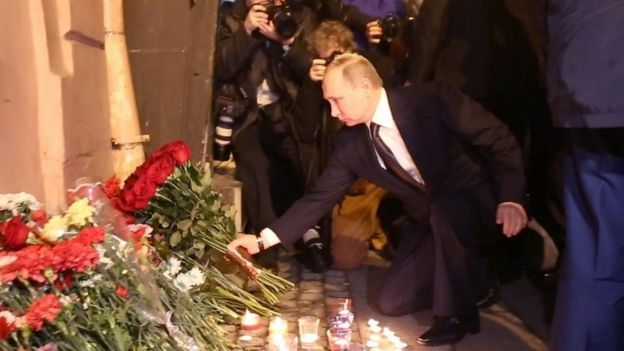
Image copyright AFP
The death toll was raised from 11 to 14 on Tuesday morning after three people died in hospital.
Russian President Vladimir Putin, who was in St Petersburg - his home city - when the blast occurred, visited the scene on Monday evening and laid flowers at a makeshift shrine.
Russian investigators have given few details. No group has said it was responsible.
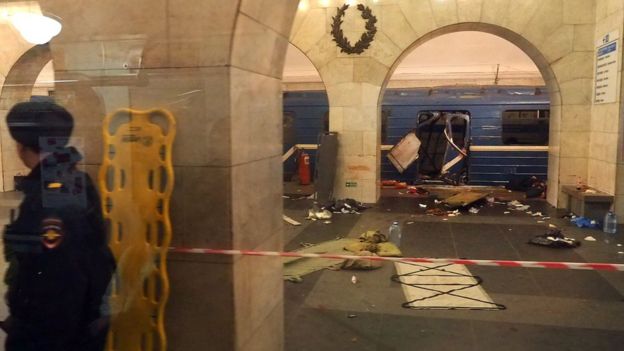
Image copyright AFP/Getty Images
The White House said President Donald Trump had spoken to Mr Putin by phone and offered "full support" in bringing those responsible to justice.
"Both President Trump and President Putin agreed that terrorism must be decisively and quickly defeated," a statement said.
German Chancellor Angela Merkel described the blast as a "barbaric act" and EU foreign policy chief Federica Mogherini said Europe's thoughts were with the Russian people.
What we know so far
Events as they happened
In pictures: St Petersburg metro explosion
First images from the scene showed a train at Tekhnologichesky Institut station with a hole blown in its side and wounded passengers on the platform.
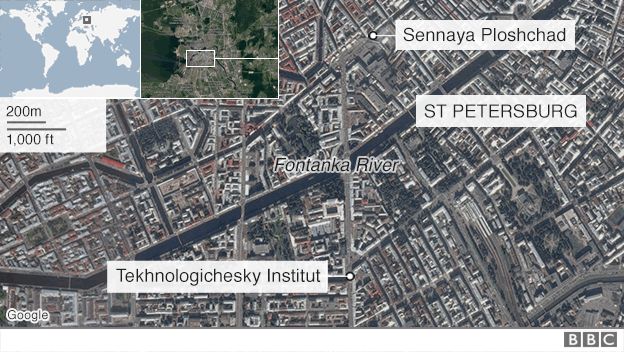
Initial reports suggested there had been two explosions, one each at Sennaya Ploshchad and Tekhnologichesky Institut stations.
But the Russian National Anti-Terrorist Committee later confirmed there had been only one explosion, between the two stations, at about 14:30 local time
Senior investigator Svetlana Petrenko told Russian media the train driver's decision to continue to the next station almost certainly helped save lives, as it allowed people to be rescued quickly.
Andrei Przhezdomsky, the head of the National Anti-Terrorist Committee, said the explosion was caused by "an unidentified explosive device".
The discovery of an explosive device at another station, Ploshchad Vosstaniya, also suggested a co-ordinated attack.
Interfax said the bomber was known to have links to radical Islam.
The news agency said he died in a suicide blast and was identified through his remains. But the president's spokesman, Dmitry Peskov, would not comment on reports a suicide bomber was to blame.
Another agency, Tass, reported that a woman may also have been involved in the explosion.
Several transport hubs in Russia have, however, been attacked. In 2010, 38 people died in a double suicide bombing on the Moscow metro.
And a year later, a bomb exploded on a high-speed train travelling between Moscow and St Petersburg, killing 27 and injuring another 130.
Both attacks were claimed by Islamist groups.
Information source:http://www.bbc.com/news/world-europe-39486640

沒有留言:
張貼留言